Climate Vulnerability of Hydropower Sector

Prioritizing climate change adaptation needs for hydropower sector in China
Potential impacts of climate change on hydropower have been widely recognized. Given that China consistently ranks among the world’s leading countries in installed hydropower capacity, there is an urgent need for long-term, high–spatial-resolution assessments of hydropower-climate risk to identify the spatiotemporal priorities of adaptation policies and to enable the efficient allocation of limited adaptation resources. This study evaluates changes in economic returns and electricity generation in China’s hydropower sector under climate change throughout the twenty-first century, providing quantitative support for national energy security management. It further simulates the cascading effects of hydropower losses, emphasizing the multiple feedbacks between the climate system and socio-economic systems (Fig. 1).
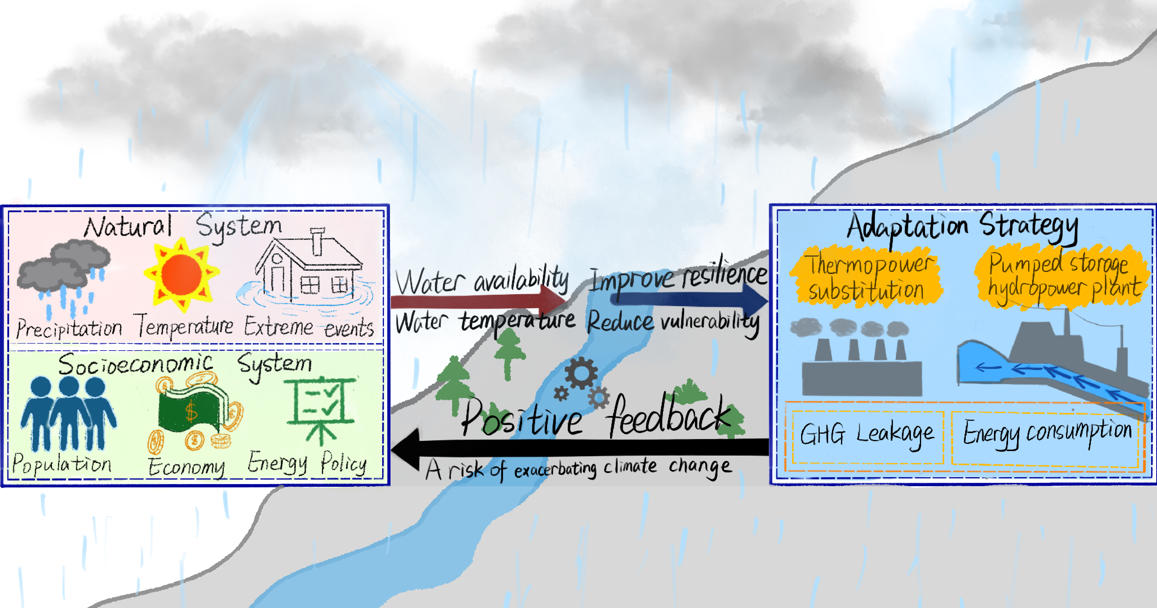
To capture distinct risk characteristics—high-probability, low-impact changes and low-probability, high-impact events—the study constructs a set of climate indicators reflecting shifts in average climate conditions as well as changes in the frequency of extreme weather events. Using micro-level panel data for 5,082 hydropower plants across China from 1998 to 2013, we apply econometric models to uncover the coupled relationship between hydropower performance and climate variability, as well as regional heterogeneity across different climate zones.
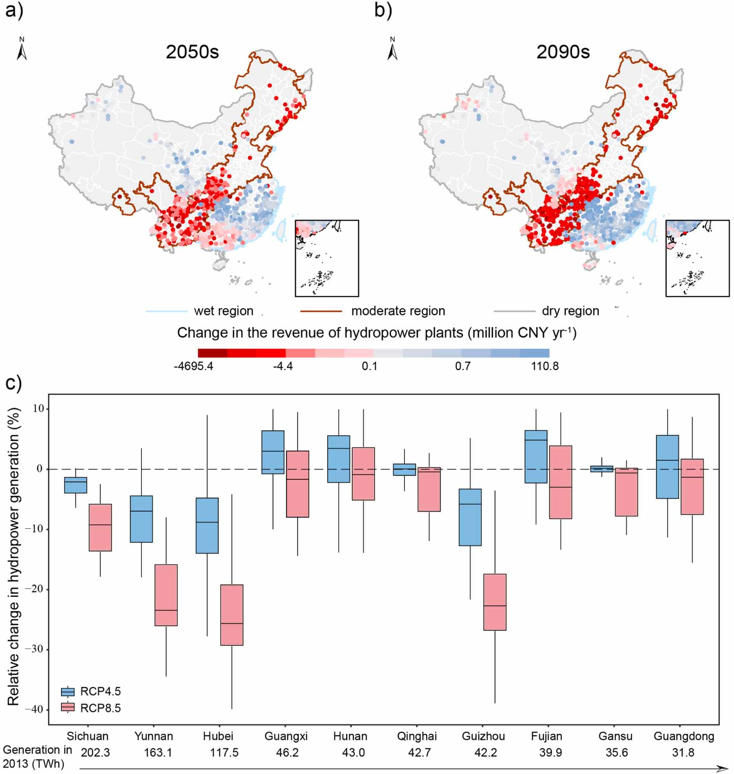
Based on 21 global climate models (GCMs) from the CMIP5 ensemble under two climate scenarios (RCP 8.5 and RCP 4.5), and incorporating historically estimated climate–hydropower relationships, we project annual, plant-level economic impacts on hydropower throughout the twenty-first century and estimate damage functions for precipitation and temperature. The results indicate that under the RCP 8.5 scenario, average economic losses in China’s hydropower sector could reach 9.34%±1.21% by the end of the century—approximately four times higher than under RCP 4.5. Hydropower-intensive regions, including Yunnan and Sichuan provinces in Southwest China and Hubei province in Central China, are projected to face particularly substantial losses, with some provinces experiencing reductions exceeding 20% by the century’s end (Fig. 2).
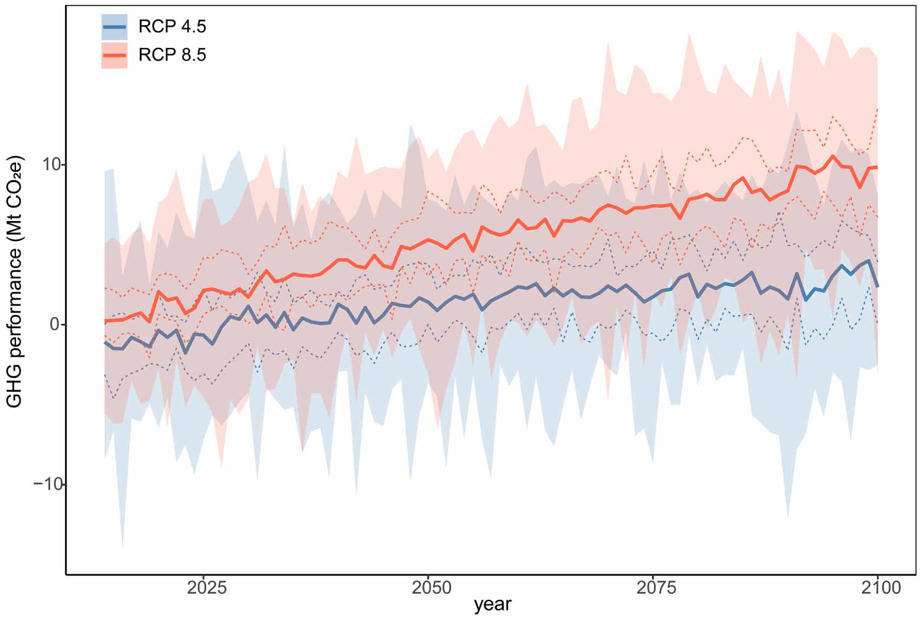
By integrating plant-level revenue panel data with generation statistics from the China Hydropower Yearbook and applying a random forest model, the study establishes a nonlinear relationship between hydropower revenue and electricity generation, enabling further quantification of projected generation losses over the century. Given that renewable technologies such as wind and solar power are also subject to climate constraints, the analysis assumes that part of the lost hydropower generation would be replaced by thermal power. Combining projected energy mix data under different climate scenarios, the results suggest that carbon leakage associated with hydropower losses could reach 467.56±202.63 Mt (Fig. 3).
Cite this article:
Gu, W., He, W., Su, H., Liu, B*. Prioritizing climate change adaptation needs for hydropower sector in China. Environmental Research Letters 17, 034040 (2022). https://iopscience.iop.org/article/10.1088/1748-9326/ac4c1b