Crop Migration and Environmental Sustainability
Climate adaptation through crop migration requires a nexus perspective for environmental sustainability in the North China Plain
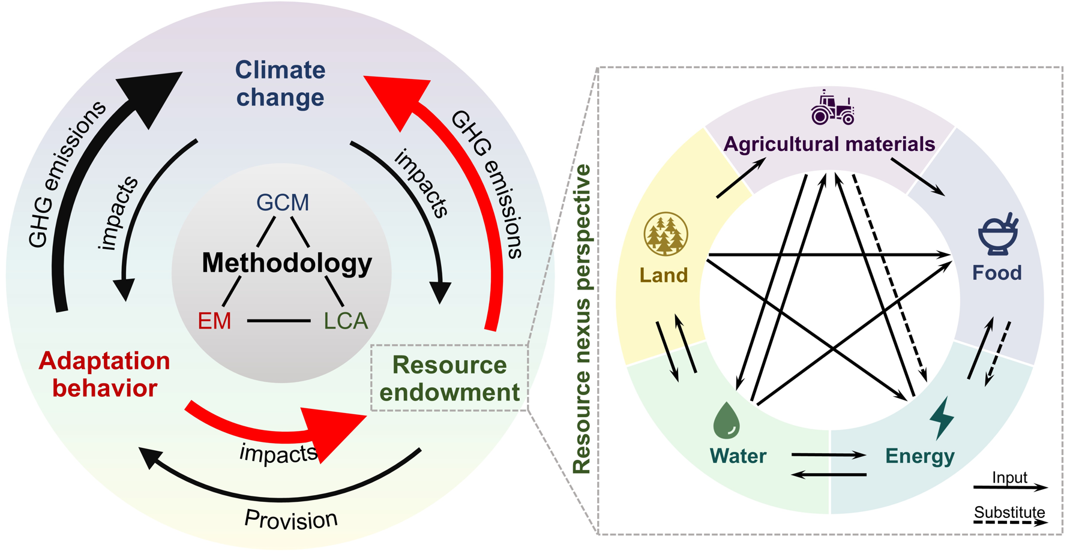
Agricultural production is progressively shifting toward regions with more favorable climatic conditions to stabilize and enhance yields under climate change. However, the cascading environmental consequences of such migration remain insufficiently examined. During agricultural production, agricultural inputs (e.g., fertilizers and pesticides), land, water, energy, and food systems are closely interconnected. As crop cultivation shifts geographically, patterns of agricultural inputs, irrigation, energy use, and production structures are correspondingly altered. Consequently, climate-induced crop migration may generate multiple climatic and environmental feedbacks. By incorporating a resource nexus perspective into simulations of adaptive behavior, our modelling framework captures how adaptation decisions propagate across resource systems, amplify through interlinkages, and ultimately feed back into the climate-environment system (Fig. 1).
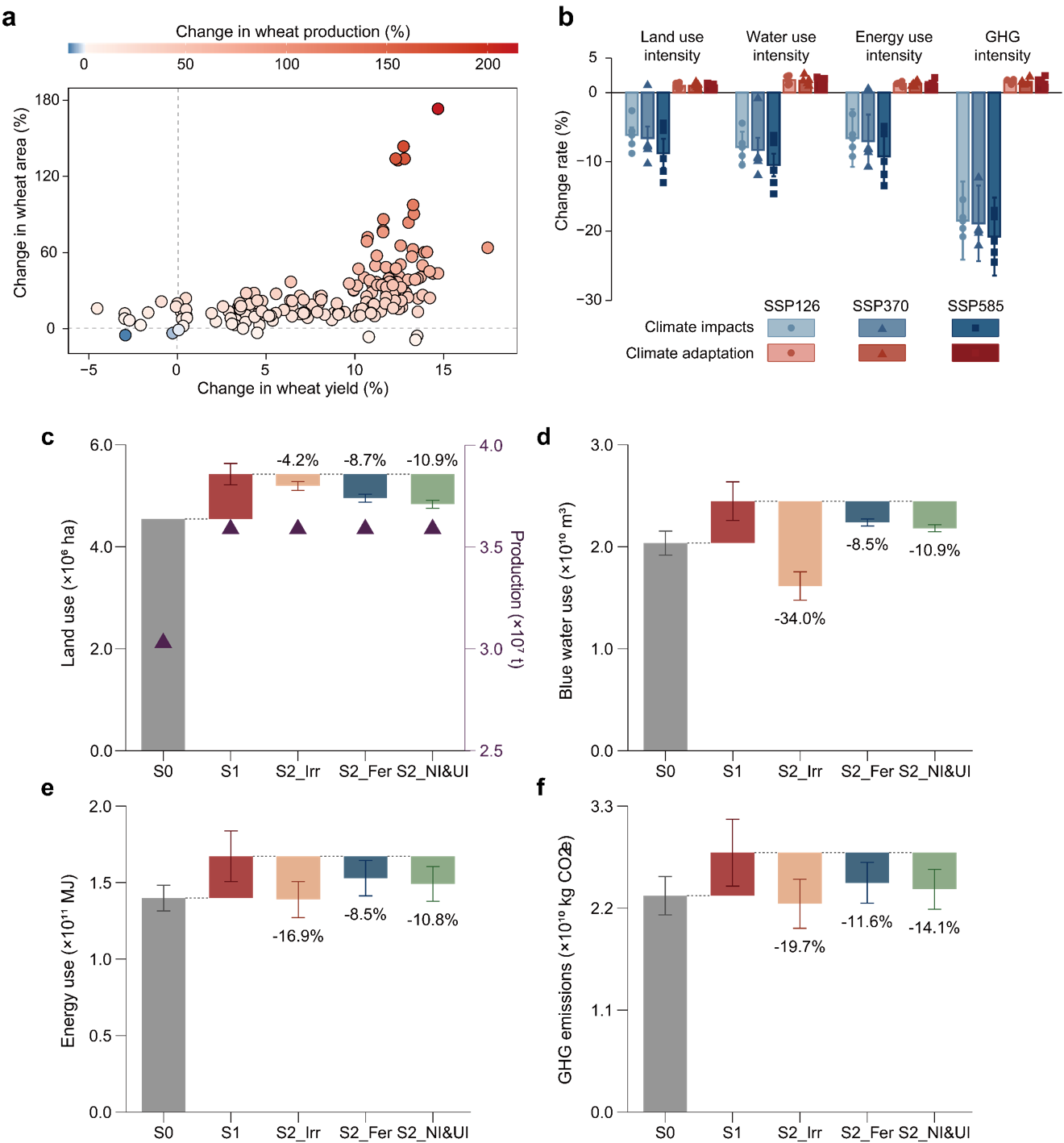
By integrating CMIP6 climate projections, machine learning and econometric models, and life cycle assessment models, the study quantifies future migration trajectories of wheat and maize cultivation in the North China Plain under different climate scenarios, along with associated changes in land, water, energy use, and carbon emissions. Results indicate that by the 2050s, a northward shift in the center of wheat cultivation (15-17 km) could increase total wheat production by approximately 18.5% (Fig. 2a). However, because areas with higher environmental impact intensities account for a larger share of cultivated land after migration, the ~18.5% gain in wheat production comes at the cost of increased land use (~19.2%), water consumption (~20.2%), energy use (~19.5%), and carbon emissions (~19.9%) (Fig. 2b).
The study further evaluates optimized adaptation strategies to enhance environmental sustainability alongside northward wheat migration, including drip fertigation and improved nitrogen management practices (e.g., controlled-release fertilizers, nitrification inhibitors, and urease inhibitors). Overall, drip fertigation demonstrates more substantial environmental benefits, reducing additional land use (~4.2%), water consumption (~34.0%), and energy use (~16.9%) associated with crop migration. By alleviating groundwater extraction pressures in the North China Plain and lowering nitrogen application intensity, it could also reduce greenhouse gas emissions by approximately 19.7% (Fig. 2c-f). At the global scale, optimized local adaptation strategies in the North China Plain have the potential to enhance regional self-sufficiency and reduce reliance on wheat imports, thereby avoiding approximately 0.20 Mt CO2e of carbon leakage embodied in international wheat trade.
Agricultural production in the North China Plain represents a microcosm of the multiple challenges confronting global agriculture, including freshwater scarcity, intensifying climate change, and environmental degradation. The integrated framework developed in this study, combined with multi-regional, multi-scale, and high-resolution datasets, provides a scalable approach for simulating agricultural adaptation and optimizing irrigation and fertilization management across broader regions, thereby promoting synergies between climate adaptation and environmental impact mitigation.
Cite this article:
Gu, W., Ma, G., Wang, R. et al. Climate adaptation through crop migration requires a nexus perspective for environmental sustainability in the North China Plain. Nat Food 5, 569–580 (2024). https://doi.org/10.1038/s43016-024-01008-8