Water Inequity in Global Agricultural Trade
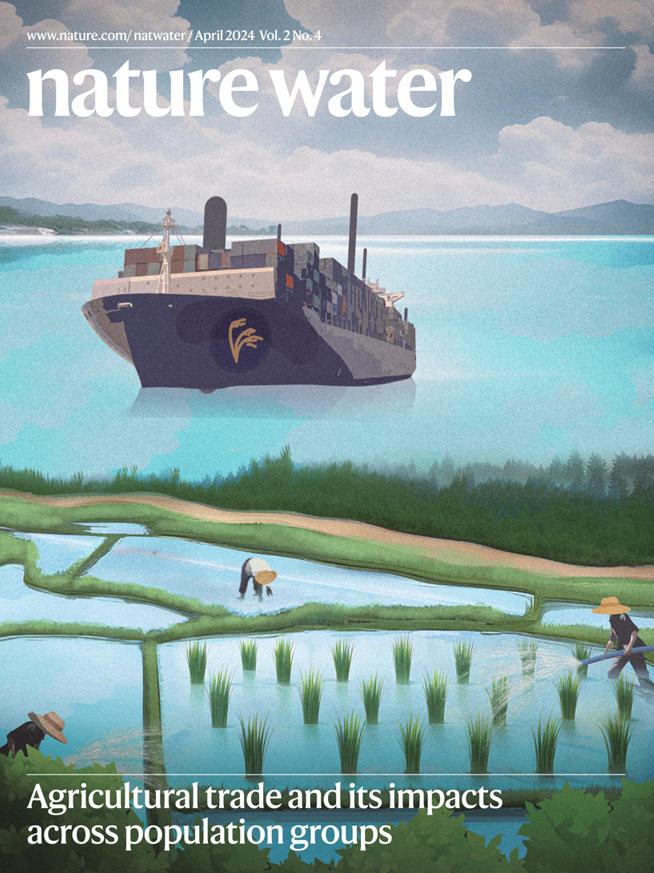
The asymmetric impacts of international agricultural trade on water use scarcity, inequality and inequity
Water resources are closely linked to multiple United Nations Sustainable Development Goals (SDGs). Globally, more than 2 billion people live in countries experiencing severe water stress, and approximately 1.2 billion people still lack access to basic safely managed drinking water services. Virtual water transfers associated with agricultural trade may help alleviate water scarcity (SDG 6), reshape the global distribution of water use, and generate heterogeneous impacts across income groups. However, previous research on water risk has primarily focused on perturbations in the hydroclimatic cycle. In contrast, limited attention has been given to how human activities redistribute water-related risks and induce heterogeneous socioeconomic responses. This gap constrains the development of targeted adaptation strategies for different regions and populations and ultimately hinders progress toward global sustainable water management.
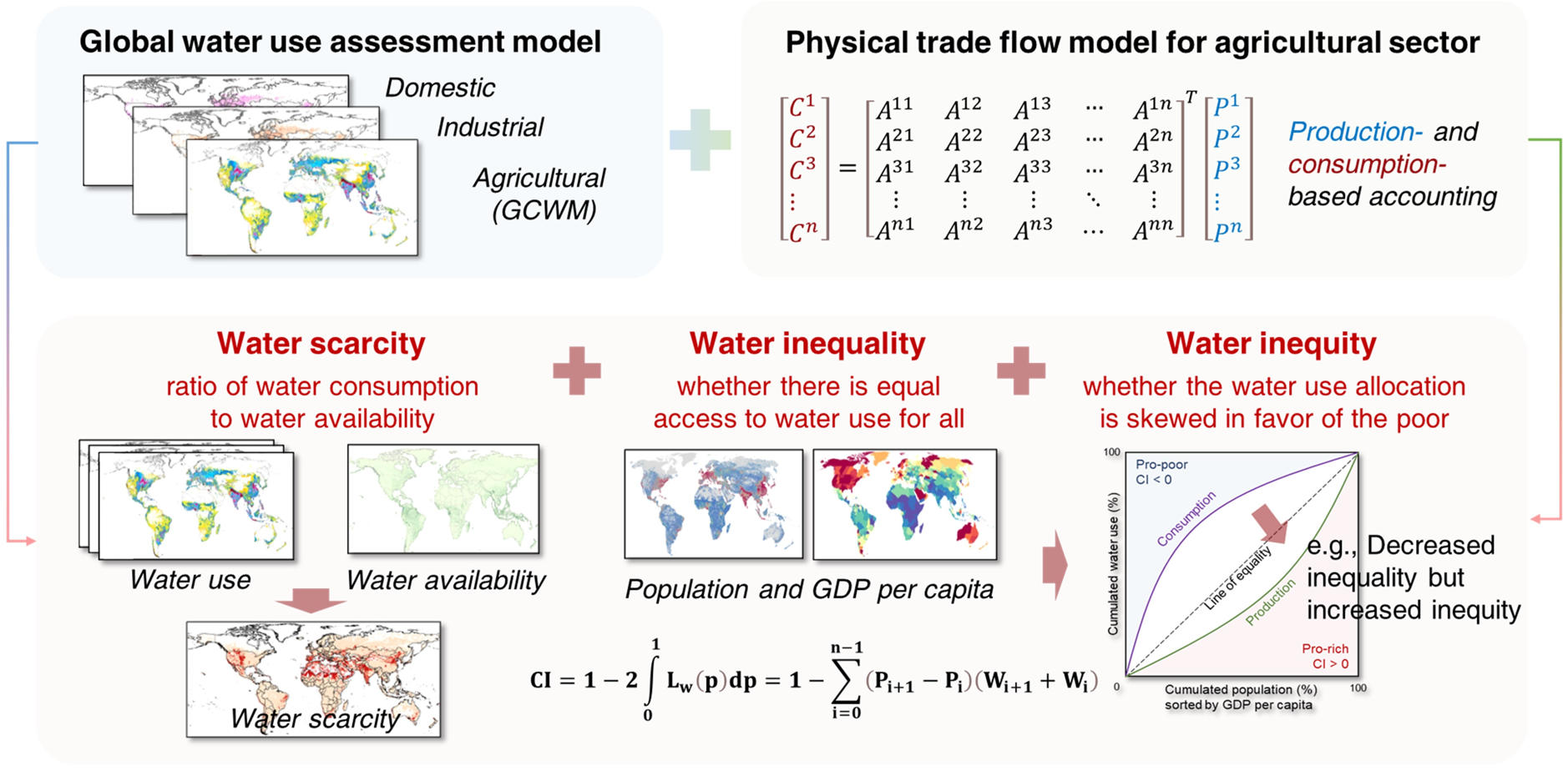
To address this issue, building upon prior work on tele-coupled water risk mechanisms and impact assessment, we develop an integrated assessment framework (Fig. 1). By coupling a crop water requirement model, a physical trade flow model, and an equity assessment model, the study constructs a comprehensive framework to quantify water risk redistribution mechanisms and their equity implications. Using historical datasets, the study systematically evaluates how international agricultural trade reshapes the global allocation of scarce water resources and assesses the resulting differentiated impacts across income groups.
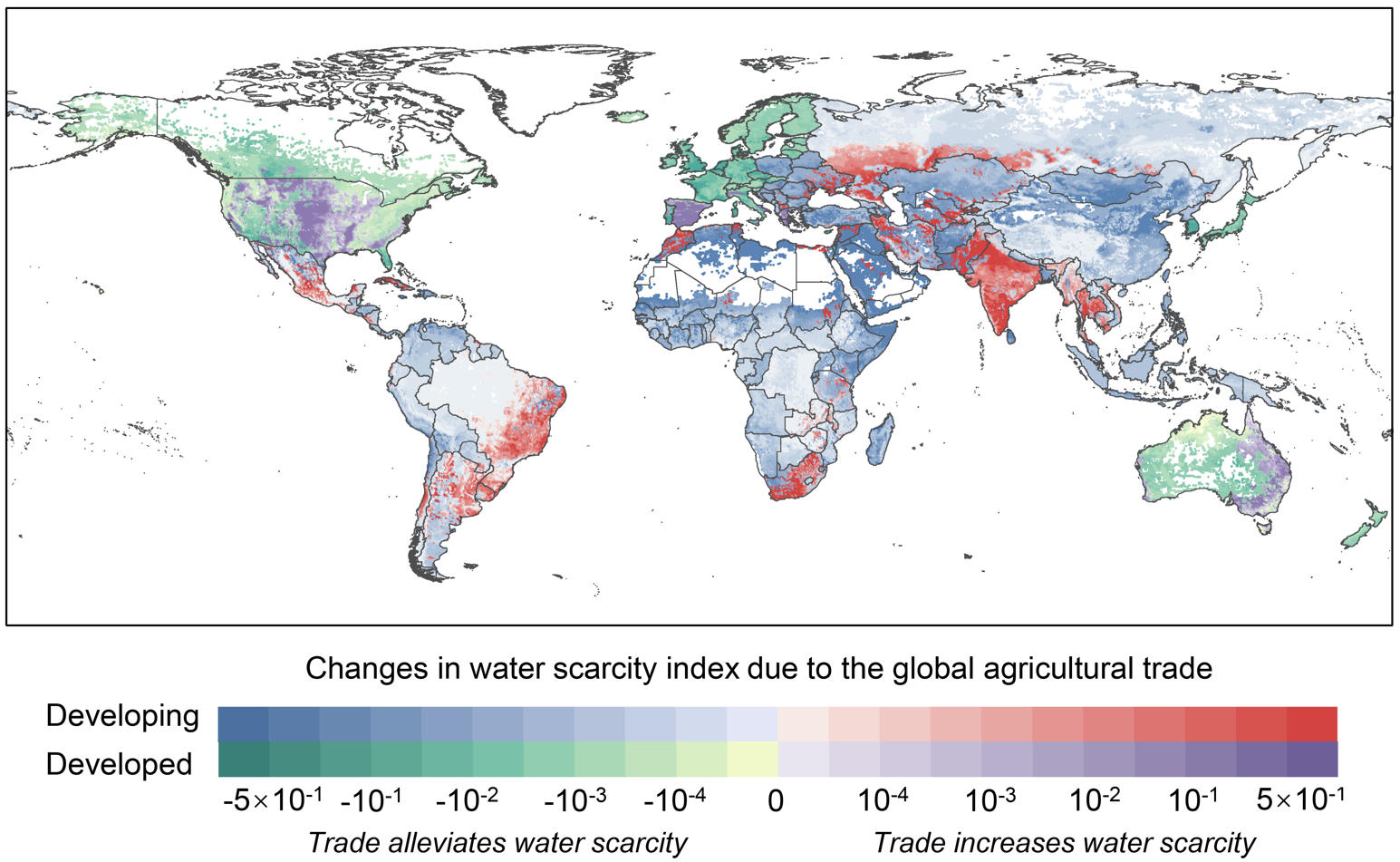
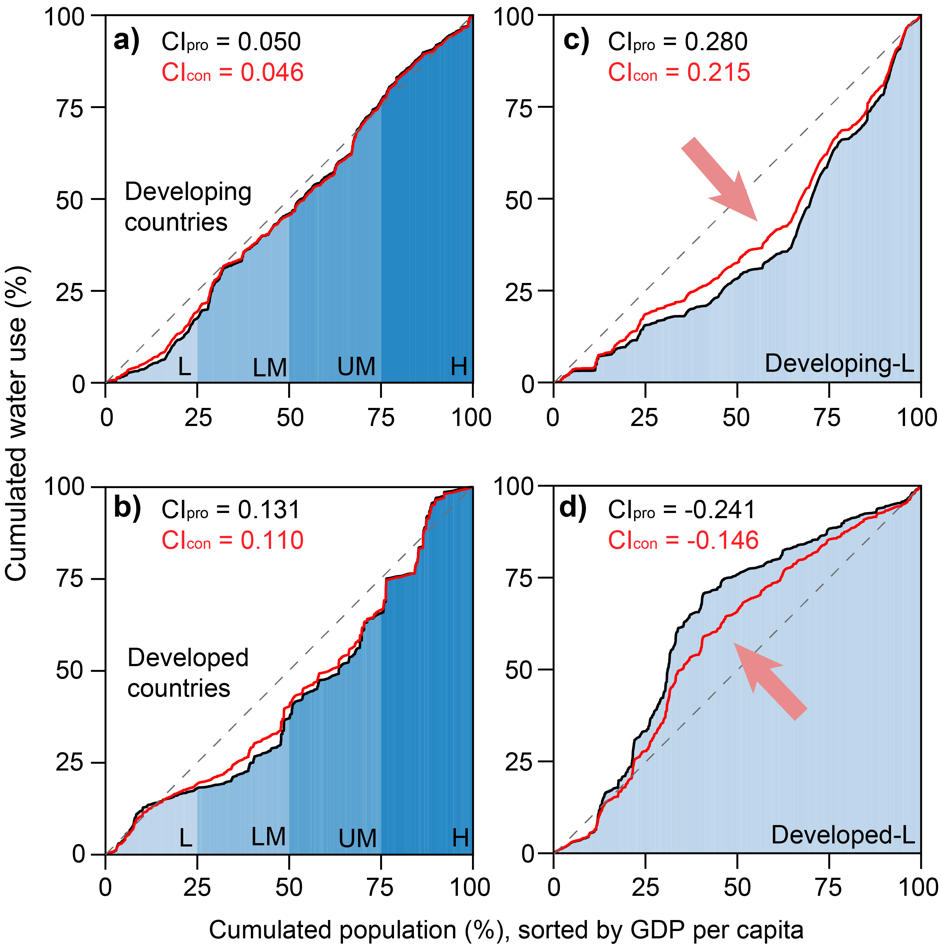
The results show that although agricultural trade generally alleviates global water scarcity, substantial regional heterogeneity exists and benefits are disproportionately accrued by wealthier populations (Fig. 2). In developing countries, agricultural trade reduces water use equity by approximately 30%; that is, the concentration of water use toward the poorest populations declines by about 30% on average. In contrast, in developed countries, agricultural trade improves water use equity by roughly 65%, increasing the concentration of water use toward relatively poorer populations (Fig. 3). Similarly, in developing countries, 35% of the population simultaneously faces intensified water scarcity and increased inequity in water use, with average incomes only 84% of the national per capita income. Conversely, in developed countries, relatively lower-income groups (13% of the population) tend to benefit from concurrent reductions in both water scarcity and water-use inequity.
The study further identifies the relative contributions of different crop types, particularly staple crop trade such as rice and cash crop trade such as cotton, as well as different trade patterns, especially extensive South-South trade cooperation, to the transmission of water-related risks. By elucidating the mechanisms through which water risks are redistributed toward lower-income populations, this work provides a methodological and data foundation for future research on cross-population transmission of water risks under climate change.
In the context of climate change and globalization, this study underscores that while international trade plays a crucial role in safeguarding global food security, it also reshapes water allocation patterns with disproportionate consequences for populations with limited adaptive capacity. The findings highlight the need for targeted regulatory strategies tailored to heterogeneous population groups. Such strategies may help overcome the current methodological limitation of end-user homogeneity in water risk assessments, mitigate the relative disadvantage of low-income populations in international agricultural trade, and promote equitable, inclusive, and sustainable global water resource governance.
Cite this article:
Gu, W., Wang, F., Siebert, S. et al. The asymmetric impacts of international agricultural trade on water use scarcity, inequality and inequity. Nat Water 2, 324–336 (2024). https://doi.org/10.1038/s44221-024-00224-7
Gu, W., Qin, Y. Targeted opportunities to mitigate water scarcity, inequality, and inequity embedded in international food trade for vulnerable countries. Water Research 267, 122568 (2024). https://doi.org/10.1016/j.watres.2024.122568